

Key Takeaways: How AI Bot Traffic Is Changing Search
AI Bot Traffic Is Exploding: AI bot traffic has surged by 300%, rapidly changing how website traffic works.
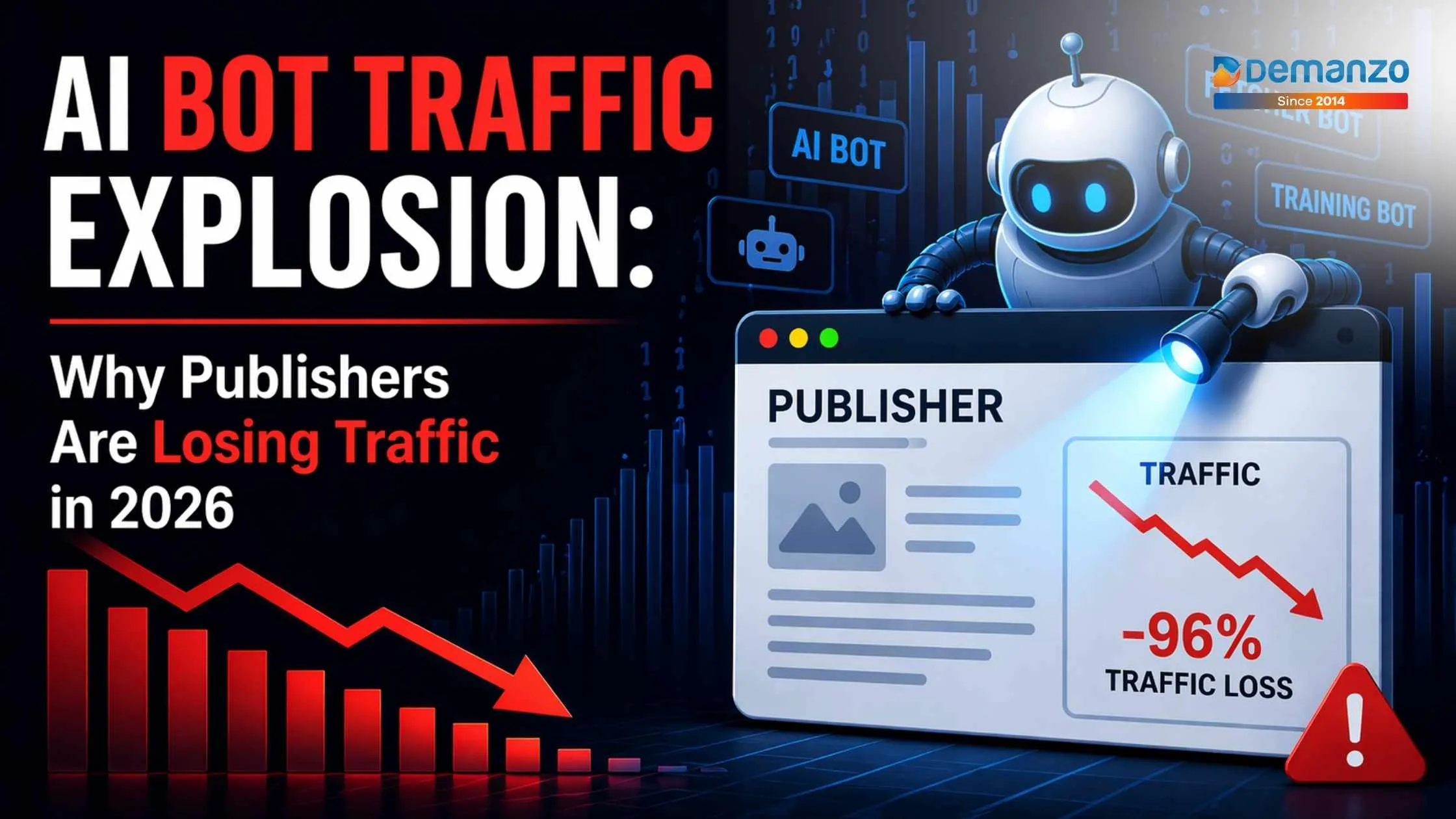
Publishers Are Losing Traffic: AI-generated answers reduce clicks, with up to 96% less traffic compared to traditional search.
Fetcher Bots Are the Biggest Threat: Real-time AI bots deliver instant answers, stealing traffic before users visit your site.
Zero Click Search Is Growing: Users now get answers directly from AI tools without clicking websites, impacting visibility and revenue.
New Monetization Models Are Emerging: Pay-per-crawl and bot access control could help publishers regain value from their content..
You work hard to create great content. You write blog posts, build landing pages, and share helpful guides. But here is a question most marketers are not asking: Who is actually reading your content?
In 2025, a big part of the answer is: bots. And not just any AI-powered bots that are growing faster than ever before. A major report by Akamai found that AI bot traffic surged by 300% in 2025. That is a tripling in just one year.
If you run a website, a blog, or any kind of online business, this matters to you. Let’s break it down in simple terms: what it is, why it hurts, and what you can do about it.
What Is Bot Traffic, and Why Should You Care?
Bot traffic is web traffic generated by automated software programs, not real humans. A “bot” is basically a computer script that visits websites on its own. Some bots are helpful, like Google’s search crawler, which helps your site show up in search results.
But today, a new wave of AI bots is visiting sites for very different reasons. These bots are built by AI companies. They crawl your website, read your content, and feed that information into tools like ChatGPT, Gemini, and other AI assistants.
Here is the problem: these bots do not bring value back to you. They take your content and use it to answer user questions without ever sending those users to your website.
That means your hard work fuels someone else’s platform.
According to the Akamai report, two types of AI bots are causing the most damage:
● Training bots – These crawl your site to collect data that AI companies use to build and train their language models.
● Fetcher bots – These are newer and more dangerous. They visit your site in real time, grab your latest content, and instantly deliver it as an AI-generated answer to a user. The user never clicks through to your site.
Fetcher bots are the bigger threat because they steal the value the moment you create it.
How Bad Is the Damage from AI Bot Traffic?
The numbers are striking. Let’s look at what the data actually shows.
AI chatbot referrals now send about 96% less traffic than traditional Google search. That means if Google used to send 100 visitors to your site, an AI platform sending the same answer only brings you about 4. And here is the kicker: when AI answers cite a source, users only click those links roughly 1% of the time.
So your content is doing all the heavy lifting, but you are getting almost none of the reward.
It gets worse. All that traffic does not come for free. These bots still hit your servers, consume your CDN resources, and drive up your infrastructure costs without ever buying anything, subscribing, or clicking an ad.
In the Akamai data, OpenAI generated the highest volume of AI bot traffic targeting media and publishing sites. Publishers made up 40% of all OpenAI bot requests. AI training crawlers accounted for 63% of all AI bots targeting media, while AI fetchers made up another 24%, and that share is growing fast.
The result? Fewer pageviews. Higher costs. Weaker brand visibility. And shrinking ad and subscription revenue.
How Bot Traffic Is Changing the Way People Find Content
Not long ago, the path was simple. Someone typed a question into Google. Google showed a list of links. The person clicked one. They landed on your site, read your content, and maybe signed up for your newsletter.
That whole system is breaking down.
Now, people type questions into AI platforms like ChatGPT or Gemini. These tools give them an instant answer, often built from content scraped off websites like yours. The user gets what they need without ever leaving the chat window.
This is called a zero click experience. The user’s question gets answered. But the website that had the answer gets zero traffic, zero engagement, and zero revenue.
This shift from search engines to AI “answer engines” is one of the biggest changes happening online right now. And it is moving fast. According to cybersecurity firm Human Security, automated traffic is now growing eight times faster than human traffic.
The old goal was to rank on Google. The new goal is to show up inside AI answers and to make sure you get credit and traffic when you do.
What Smart Websites Are Doing to Fight Back
The good news is that website owners are not helpless. Publishers and marketers are starting to find smart ways to protect their content and their traffic.
Here are the approaches that are working:
1. Monitor and classify bot traffic. You cannot fight what you cannot see. Smart teams are using tools to track which bots are visiting, how often, and what they are taking.
2. Block harmful scrapers selectively. Rather than blocking all bots (which would stop Google, too), savvy publishers are blocking or slowing down the bots that offer no value in return. One tactic is “tarpitting”, slowing down malicious crawlers so they waste their own time.
3. Allow only approved bots. Some publishers, like The Atlantic and People Inc., now only allow bots from companies with which they have licensing deals or partnerships. If an AI company wants your content, they have to pay for it.
4. Build direct relationships with your audience. Email lists, online communities, and owned platforms give you a way to stay connected with your audience, no matter what happens in search or AI.
5. Create content AI cannot copy. Original research, real customer stories, expert opinions, and proprietary data are hard for AI to replicate. These are your most valuable assets right now.
What’s Coming Next: Pay-Per-Crawl and New Rules
A new way of doing things is starting to happen. By allowing artificial intelligence bots to take content for free, some companies are making tools that make these bots pay for access to the content.
There are platforms like TollBit and identity tools like Know Your Agent that are working to figure out who the bots are and make them pay every time they access the content of a website. The main goal of this is to change the way bots take content without permission into a transaction where the owner of the content knows who is using their content and gets paid for it.
This Pay-Per-Crawl model is still in its stages. But it signals a major shift in how the web will work going forward.
| Stay ahead of AI, visibility, and demand generation trends. Follow Demanzo for weekly breakdowns that decode what actually moves the needle in B2B marketing. |
Frequently Asked Questions (FAQ):
2: Is all traffic bad?
No. Some bots are helpful, like Googlebot, which helps your pages rank in search. The harmful kind are AI training bots and fetcher bots that take your content without sending traffic back to you.
3: How do I know if my site has a bot traffic problem?
Look at your analytics for unusual traffic spikes, very low engagement rates (near-zero time on page), or strange user agent strings in your server logs. High traffic with zero conversions can also signal heavy bot activity.
4: Why did my website traffic drop even though my content is ranking?
If your content shows up in AI-generated answers, users may be getting the information they need without clicking your link. This zero-click behavior is a major reason many sites are seeing traffic drops despite strong rankings.
5: Can I block AI bots from my website?
Yes. You can use your robots.txt file to block known AI crawlers. You can also use services like Cloudflare or Akamai to detect and block unwanted bot traffic. However, blocking all bots might also stop helpful ones like Google, so selective blocking is smarter.
6: What is the difference between a training bot and a fetcher bot?
A training bot collects your content over time to help build AI models. A fetcher bot grabs your content in real time to answer a specific user query right now. Fetcher bots are considered more damaging because they deliver your value instantly with no delay and no traffic sent your way.
7: What should B2B marketers do about AI bot traffic?
Focus on three things: build direct audience channels you own (email, community), create original content that AI tools cannot easily replicate, and optimize to appear in AI-generated answers with strong authority signals. Relying only on organic search traffic is no longer a safe strategy.
2: Is all traffic bad?
No. Some bots are helpful, like Googlebot, which helps your pages rank in search. The harmful kind are AI training bots and fetcher bots that take your content without sending traffic back to you.
3: How do I know if my site has a bot traffic problem?
Look at your analytics for unusual traffic spikes, very low engagement rates (near-zero time on page), or strange user agent strings in your server logs. High traffic with zero conversions can also signal heavy bot activity.
4: Why did my website traffic drop even though my content is ranking?
If your content shows up in AI-generated answers, users may be getting the information they need without clicking your link. This zero-click behavior is a major reason many sites are seeing traffic drops despite strong rankings.
5: Can I block AI bots from my website?
Yes. You can use your robots.txt file to block known AI crawlers. You can also use services like Cloudflare or Akamai to detect and block unwanted bot traffic. However, blocking all bots might also stop helpful ones like Google, so selective blocking is smarter.
6: What is the difference between a training bot and a fetcher bot?
A training bot collects your content over time to help build AI models. A fetcher bot grabs your content in real time to answer a specific user query right now. Fetcher bots are considered more damaging because they deliver your value instantly with no delay and no traffic sent your way.
7: What should B2B marketers do about AI bot traffic?
Focus on three things: build direct audience channels you own (email, community), create original content that AI tools cannot easily replicate, and optimize to appear in AI-generated answers with strong authority signals. Relying only on organic search traffic is no longer a safe strategy.
