

Quick Facts About Demand Generation:
● Demand generation builds awareness and interest before a buyer is ready to purchase.
● It focuses on education, not just direct selling—ideal for B2B, SaaS, and IT industries.
● In B2B, it helps manage long sales cycles and multiple decision-makers.
● For SaaS, demand generation supports freemium and product-led growth models.
● Strong content, SEO, webinars, and case studies are key parts of a demand generation strategy.
● Demanzo helps brands plan and execute high-impact demand generation campaigns.
What is Demand Generation?
Demand generation in marketing is the strategy used to raise awareness of and interest in the goods or services of a firm. It’s about developing a long-term relationship with your target market and guiding them from ignorance about your brand to becoming engaged prospects. Demand generation is about helping your audience understand their issues and see your company as a solution, unlike conventional marketing, which sometimes jumps directly to selling. Beginning at the top of the funnel, it generates awareness and interest and proceeds down towards lead nurturing and conversion.

Demand generation is especially important in the digital world of today, as consumers conduct a lot of research before even interacting with a salesperson. Companies cannot now depend just on generic ads or cold calls. Rather, they must offer insightful analysis, useful information, and instruction that over time fosters trust. At Demanzo, we enable brands to precisely reach the correct audience with content that educates, interacts, and converts.
Role of Demand Generation in B2B Companies
Sales procedures in B2B organisations are sometimes lengthy and difficult. Several decision-makers are usually involved: finance leaders, IT leads, operations teams with varying agendas. This slows down and makes the purchase process more deliberate than in B2C.
In this situation, demand generation in B2B becomes crucial since it emphasises teaching possible consumers at all phases of their path. By use of blog entries, whitepapers, webinars, and comparison guides, B2B companies can impact decisions prior to a sales conversation even starting.
B2B buyers also want to interact with businesses they know they can trust. Demand generation helps B2B organisations remain top-of-mind and become the preferred choice when purchasing choices are made by constantly providing useful information, answering customer enquiries, and building relationships over time.
Role of Demand Generation in SaaS Companies
Operating in a very competitive market where consumers want to try products before making purchases, Software as a Service (SaaS) firms rely less on forceful sales and more on educating consumers, developing product trust, and providing value upfront.
In SaaS, demand generation typically supports a freemium model whereby consumers may access constrained functionality before upgrading. Demand generation has to concentrate on the following if this approach is to be successful:
● Clearly educating the value of the product.
● Onboarding materials, how-to tips, and video tutorials.
● Making comparison charts will enable consumers to select your tool above others.
Furthermore, many SaaS businesses depend on product-led growth (PLG). Thus, the marketing and sales process revolves mostly on the product itself. By means of demand generation, SaaS businesses can draw the appropriate consumers, inspire them to test the solution, and direct them towards paying customer status.
Role of Demand Generation in IT Companies
Complex, technological solutions such as cybersecurity systems, cloud infrastructure, or enterprise software are routinely sold by IT companies. These products demand careful presentation since most decision-makers are technical professionals needing thorough knowledge before making a purchase. Demand generation in IT businesses emphasises authority and trust development. This entails producing instructional materials addressing actual problems like: How may your solution increase operational effectiveness?
● How might it interact with current tech stacks?
● Supporting your assertions, are there any case studies or success stories?
Powerful instruments in IT demand generation are webinars, product demos, and whitepapers. They let you present your expertise, inform your audience, and establish your brand as a consistent field-based expert. Seeking to apply a concentrated demand generation approach for your IT company? Learn more about our services.
Key Components of a Demand Generation Strategy
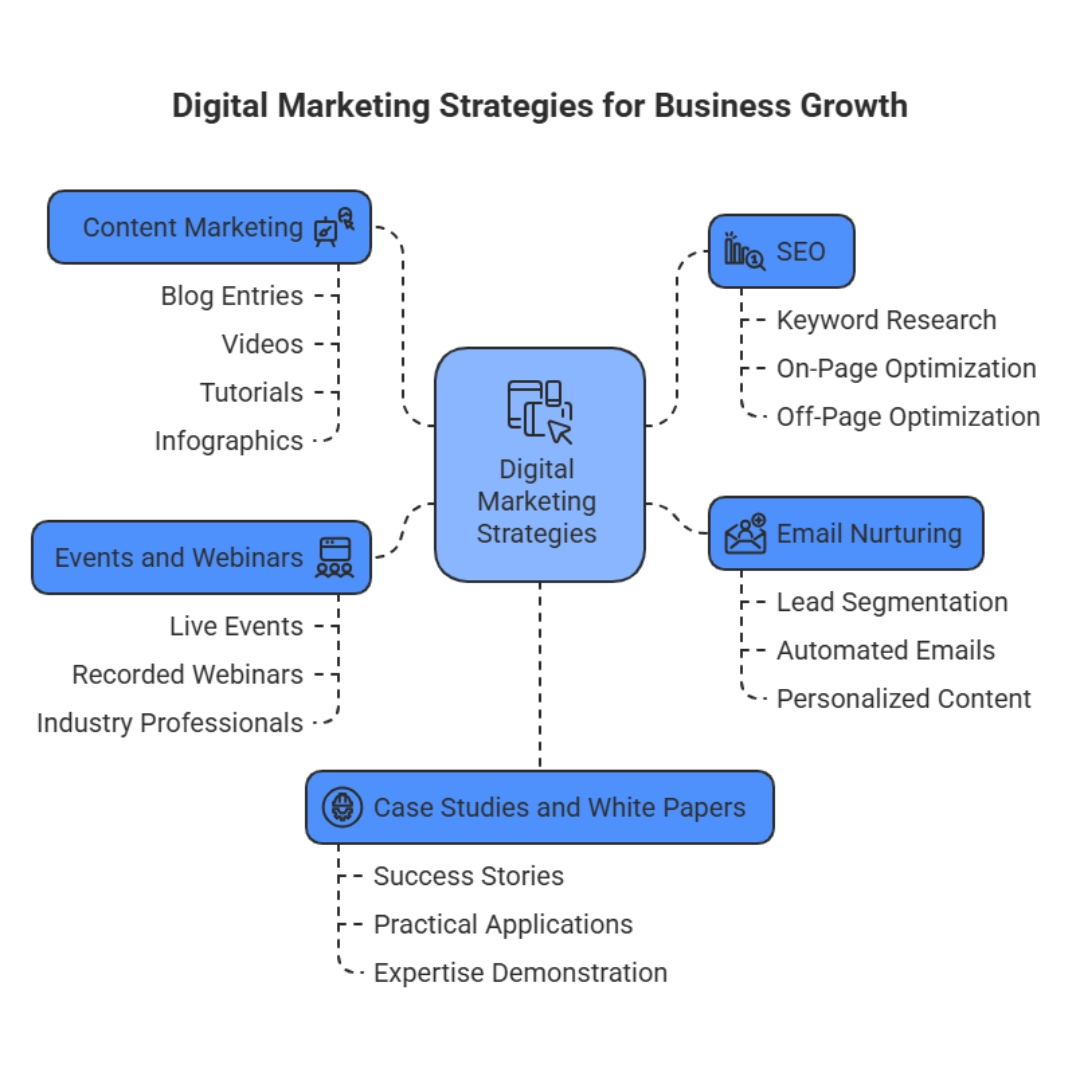
A good demand generation plan is not developed overnight. It incorporates long-term nurturing strategies, distribution methods, and content. Here are some fundamental elements:
Content Marketing:
Developing blog entries, videos, tutorials, and infographics teaching your readers and addressing their issues.
SEO (Search Engine Optimisation):
Making sure your content ranks on search engines will help prospective clients come across you when looking for pertinent topics.
Email Nurturing:
Over time, a series of useful emails sent to leads guides them across the decision-making process.
Events and Webinars:
Live or recorded events where your own staff or industry professionals directly interact with the audience.
Case Studies and White Papers:
Evidence of your knowledge and successes. These materials enable prospective consumers to see how your ideas apply in practical situations. Together, these elements generate curiosity, inform prospects, and propel them towards a purchase decision.
Real-Life Story:
Assume for a moment a SaaS company with a team collaboration product seeking demand generation. Rather than advertising direct commercials, they launch a blog series on “Remote Team Productivity.” They provide a free downloadable template for remote work planning, a webinar including a productivity coach, and comparison notes between well-known tools.
They thus draw people seeking to enhance team productivity. These consumers download the template, register for the blog, and finally test the free edition of the product. Some change to paid plans with time. Demand generation thus attracts, educates, and converts the appropriate audience.
Conclusion:
Demand generation is about developing close bonds with your audience, not only about marketing. Demand generation helps you attract, educate, and convert high-quality prospects regardless of your business B2B dealing with long buying cycles, SaaS companies providing freemium tools, or IT firms selling technical solutions.
Done properly, it not only generates leads but also informed ones who are more likely to convert and trust your brand. Would you like to create a successful demand generation plan? Our areas of expertise at Demanzo are creating demand generation engines for SaaS, B2B, and IT businesses. Get in touch with us today to learn how we might enable you to scale using more intelligent tactics.
Frequently Asked Questions (FAQ)
What is an example of demand generation?
A good example of demand generation is a company publishing a helpful blog series on a common industry problem, then offering a free eBook or webinar to dive deeper. When people sign up, they receive more helpful emails over time. This keeps the brand top of mind and builds trust, even before a sales conversation starts.
What is the concept of demand generation?
The concept of demand generation is about building interest in your brand before someone is ready to buy. Instead of pushing a quick sale, you attract potential customers by sharing useful content, answering their questions, and educating them. Over time, this creates demand for your product or service in a natural way.
Demand generation vs lead generation
Demand generation focuses on creating awareness and interest. It happens at the very top of the funnel through blogs, webinars, videos, and SEO.
Lead generation comes after. It’s about collecting contact details (like email IDs) from people who’ve shown interest, so you can follow up with them. In short: demand gen builds interest, lead gen collects details.
Why is demand generation important for SaaS businesses?
SaaS businesses usually offer free trials or freemium models. People need to understand how the product works before buying. Demand generation helps by educating potential users, showing them the product’s value, and guiding them to upgrade or subscribe. It builds trust and shortens the time it takes for users to make a decision.
What is an example of a demand generation strategy?
A common demand generation strategy is combining SEO-optimized blog content with lead magnets like eBooks or webinars. For example, a cybersecurity company might write blog posts about common threats, then offer a free security checklist download. People who download it enter an email sequence that continues to educate them until they’re ready to buy.
Is demand generation B2B or B2C?
Demand generation is used in both B2B and B2C, but it is more common and more important in B2B. That’s because B2B sales usually involve longer decision-making processes, multiple stakeholders, and complex products. Demand generation helps B2B companies build relationships and trust before the sales pitch happens.
