

5 Key Takeaways for Winning in AI Search (AEO & GEO)
Ranking #1 Doesn’t Guarantee Traffic: Even top-ranking pages lose clicks as AI answers user queries directly on search results.
Zero-Click Searches Are Now the Majority: Over 60% of searches end without clicks, and AI-driven search pushes this even higher.
Traditional SEO Alone Is No Longer Enough: Ranking on Google doesn’t ensure visibility in AI tools. SEO and AI visibility are now different games.
AEO & GEO Are the New Growth Strategies: To stay visible, brands must optimise content to be understood, trusted, and cited by AI engines.
Visibility Now Means Being the Answer: Winning in 2026 means showing up inside AI-generated answers, not just driving clicks to your website.
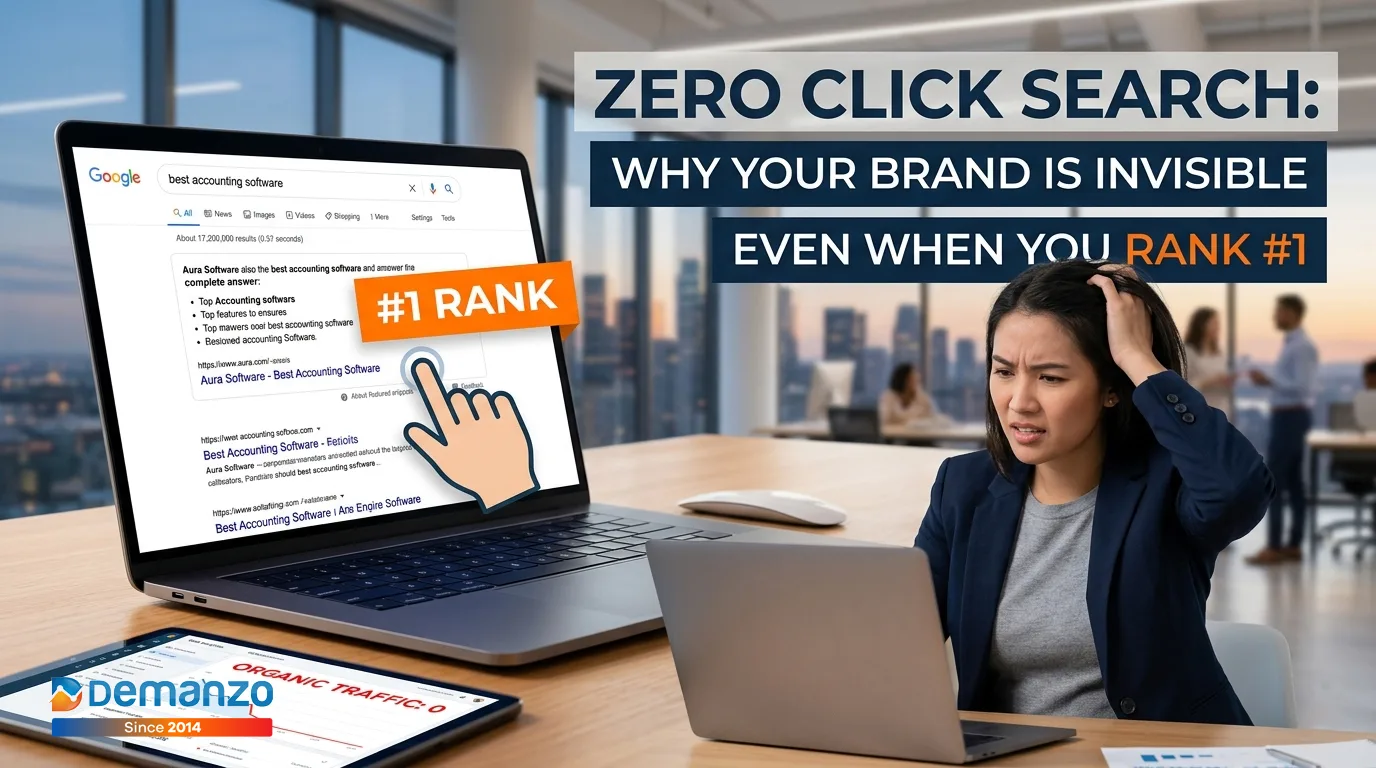
Imagine this. You work hard to get your website to the top of Google. You finally rank #1. But no one visits your site.
Sounds impossible, right? But this is happening to thousands of B2B brands right now, and it has a name: zero click search.
If you are a marketer who depends on Google traffic to grow your business, this article is for you. We will explain what zero click search is, why it is changing everything, and what you can do about it today.
What Is Zero Click Search (And Why Should You Care)?
A zero click search happens when someone types a question into Google and gets the answer right there on the results page without clicking on any website.
Think about when you search “How many ounces in a cup?” Google shows you the answer instantly. You never visit a website. That is a zero click search.
Now this same thing is happening with complex business questions, too. Buyers ask things like “What is the best B2B demand generation tool?” and AI tools give them a full answer without sending them to your website.
Here is the shocking part:
● Around 60% of traditional Google searches end without a click, according to data from Bain and other research firms.
● When Google’s AI Mode is active, that number jumps to 93% of searches ending without a single click to an external website.
● Only 1% of users click on links inside an AI Overview, according to Pew Research.
So even if your content appears in an AI answer, there is almost no chance someone clicks through to your site. The answer engine has already done the job.
This is not a small shift. The zero click rate has climbed steadily from around 50% in 2019 to nearly 65% in 2026, and it keeps growing. For B2B marketers who still measure success by website visits and clicks, this is a wake-up call.
How Zero Click Searches Are Killing Traditional SEO
For years, the goal of SEO was simple: rank higher, get more clicks, get more traffic. That formula worked well until AI changed the game.
AI Overviews now appear in 89% of brand search results. And according to Ahrefs, AI Overviews reduce organic click-through rates for the number one position by up to 58%.
Let that sink in. You can be at the very top of Google and still lose more than half your expected traffic because an AI box answers the question before anyone even scrolls down to your link.
Fewer than 10% of sources cited in ChatGPT, Gemini, and Copilot rank in the top 10 Google organic search results for the same query. This means traditional SEO success does not automatically translate to AI visibility. They are two different games now.
In 2026, 65% of marketers say AI-driven search changes are their single biggest challenge. And yet, most marketing teams are still running the same SEO playbooks from five years ago.
The game has changed. The question is: have you changed with it?
Meet AEO and GEO, The Two Strategies That Matter Now
If traditional SEO is no longer enough, what should B2B marketers do instead? The answer lies in two new strategies: Answer Engine Optimisation (AEO) and Generative Engine Optimisation (GEO).
Answer Engine Optimisation (AEO) is the practice of making your content easy for AI tools to find, understand, and use as a direct answer. AEO focuses on providing immediate, authoritative answers to specific user queries. Unlike traditional SEO that drives traffic to websites, AEO optimises for zero-click visibility, where users get complete answers without leaving the search platform.
Generative Engine Optimisation (GEO) is the broader strategy of making sure AI tools like ChatGPT, Perplexity, Google AI Overviews, and Microsoft Copilot cite your brand when generating responses. In AI search, there are no “10 blue links.” There is one synthesised answer, potentially citing 3 to 8 sources. Either you are one of those sources, or you are invisible.
Together, AEO and GEO help your brand show up inside AI-generated answers even when no one clicks.
Industry leaders now say that integrating a GEO strategy into your marketing mix is no longer optional; it is a competitive necessity. And for B2B companies, the opportunity is still wide open. Most competitors have not started yet.
How to Optimise Your Content for AI Search (Practical Steps)
Now that you understand the problem, here is what you can do about it.
1. Write in a Question-and-Answer Format
AI tools love content that directly answers questions. Start with a clear question as a heading, then give a direct, simple answer in the first one or two sentences. This is called “answer-first” writing.
Instead of writing: “Demand generation is a critical function for modern B2B marketers…”
Write: “What is demand generation? Demand generation is the process of creating awareness and interest in your products or services so buyers come to you ready to buy.”
2. Use Structured Data and Schema Markup
The five signals that matter most for AEO are: Organisation Schema, FAQPage Schema, an llms.txt file, verifiable external mentions like Clutch and G2, and content with direct-answer blocks at the top of each page.
These are technical steps, but they make a huge difference. Schema markup tells AI tools exactly what your content is about, making it easier for them to cite you.
3. Add Expert Quotes, Stats, and Citations
Research from Princeton found that adding expert quotes boosts AI visibility by roughly 41%, statistics by about 30%, and citations by around 30%.
AI tools are looking for content they can trust. Original research, real data, and expert opinions make your content far more likely to be picked up and cited.
4. Keep Your Content Fresh
Brands in the top quartile for fresh, updated web mentions receive 10 times more AI citations than brands with stale content. Commit to a quarterly content refresh. Update your case studies, refresh your pricing pages, and rewrite comparisons as the market changes.
5. Build a Presence Beyond Your Website
AI tools pull information from across the internet, not just your website. Build brand mentions on review platforms like G2 and Clutch, engage in LinkedIn conversations, and publish original research that others reference. The more places your brand appears as a credible source, the more likely AI tools are to cite you.
Why This Matters Right Now for B2B Marketers
The shift to zero click searches is not something that might happen in the future. It is happening right now. And for B2B marketers, the stakes are especially high.
Forrester found that 89% of B2B buyers now use generative AI as a key source of self-guided research throughout their buying journey. Your buyers are already asking AI tools about your category, your competitors, and your solutions. The question is: is your brand part of the answer they receive?
AI referral traffic grew 527% year over year, and it converts at 4 to 5 times the rate of traditional organic search. This means that when a buyer does click through from an AI answer, they are already pre-qualified. They have already read a summary about you. They are ready to go deeper.
Brands will need to rethink their marketing strategies to avoid falling behind in this new era of search. To succeed, brands should move quickly on pragmatic technical optimisation strategies to set the foundation for AI readability and bold experiments to understand how to influence visibility in both search engine AI overviews and LLM engines.
The brands that act now will own their categories in AI search. The brands that wait will slowly become invisible even while ranking on page one of Google.Want more practical B2B tips on AI visibility, demand gen, and what actually moves the pipeline? Follow Demanzo for weekly breakdowns on modern B2B marketing.
Frequently Asked Questions (FAQ):
2: How common are zero click searches in 2026?
Very common. Around 60% of all Google searches now end without a click. When Google's AI Mode is active, that number rises to 93%. Even on traditional Google results, AI Overviews reduce click-through rates for the top-ranking page by up to 58%.
3: What is Answer Engine Optimisation (AEO)?
AEO is the practice of structuring your content so AI-powered tools like Google AI Overviews, ChatGPT Search, and Perplexity cite your brand when answering user questions. The goal is not just to rank in search results; it is to become the source that AI tools use to answer questions in your industry.
4: What is Generative Engine Optimisation (GEO)?
GEO is the broader practice of making your content visible across all AI-powered platforms, including ChatGPT, Gemini, Claude, Microsoft Copilot, and Perplexity. It focuses on building content that AI systems trust, cite, and recommend. GEO includes tactics like structured data, expert citations, original research, and consistent brand mentions across the web.
5: Is traditional SEO dead?
No. Traditional SEO is still important, especially for commercial and transactional searches where people still click. But SEO alone is no longer enough. You need to layer AEO and GEO on top of your existing SEO strategy to stay visible in a world where AI answers more and more questions directly.
6: How do I know if zero click searches are hurting my brand?
Check Google Search Console. If your impressions are stable but your clicks are falling, that is the classic sign of zero click impact. You are still showing up but AI is answering the question before anyone reaches your link. Tools like Semrush and Ahrefs can also show you which of your keywords now trigger an AI Overview.
7: Where should a B2B marketer start with AEO and GEO?
Start by auditing your top content pages and rewriting them in a question-and-answer format. Add FAQ schema markup to your most important pages. Include original statistics, expert quotes, and clear definitions. Then build your brand's presence on external platforms like G2, Clutch, LinkedIn, and industry publications so AI tools have multiple credible sources telling them your brand is an authority.
2: How common are zero click searches in 2026?
Very common. Around 60% of all Google searches now end without a click. When Google's AI Mode is active, that number rises to 93%. Even on traditional Google results, AI Overviews reduce click-through rates for the top-ranking page by up to 58%.
3: What is Answer Engine Optimisation (AEO)?
AEO is the practice of structuring your content so AI-powered tools like Google AI Overviews, ChatGPT Search, and Perplexity cite your brand when answering user questions. The goal is not just to rank in search results; it is to become the source that AI tools use to answer questions in your industry.
4: What is Generative Engine Optimisation (GEO)?
GEO is the broader practice of making your content visible across all AI-powered platforms, including ChatGPT, Gemini, Claude, Microsoft Copilot, and Perplexity. It focuses on building content that AI systems trust, cite, and recommend. GEO includes tactics like structured data, expert citations, original research, and consistent brand mentions across the web.
5: Is traditional SEO dead?
No. Traditional SEO is still important, especially for commercial and transactional searches where people still click. But SEO alone is no longer enough. You need to layer AEO and GEO on top of your existing SEO strategy to stay visible in a world where AI answers more and more questions directly.
6: How do I know if zero click searches are hurting my brand?
Check Google Search Console. If your impressions are stable but your clicks are falling, that is the classic sign of zero click impact. You are still showing up but AI is answering the question before anyone reaches your link. Tools like Semrush and Ahrefs can also show you which of your keywords now trigger an AI Overview.
7: Where should a B2B marketer start with AEO and GEO?
Start by auditing your top content pages and rewriting them in a question-and-answer format. Add FAQ schema markup to your most important pages. Include original statistics, expert quotes, and clear definitions. Then build your brand's presence on external platforms like G2, Clutch, LinkedIn, and industry publications so AI tools have multiple credible sources telling them your brand is an authority.
