

A SaaS SEO content cluster is a group of connected pages built around one customer problem, not just one keyword. It combines a strong pillar page, helpful supporting articles, comparison pages, and product-led content to guide users through every stage of the buying journey. When supported by smart internal linking and conversion tracking, this strategy helps attract qualified visitors, increase free trial signups, and turn organic traffic into real business growth.
Your blog gets traffic. Your rankings look fine. But your trial signups? Barely moving.
If that sounds familiar, you’re not alone. A lot of SaaS marketing teams pour budget into content every month and still can’t point to a single post that pushed someone into a trial. The traffic graph goes up and to the right. The pipeline graph doesn’t.
Here’s the honest reason why: most SaaS companies build content piles, not content clusters. They publish blog after blog on broad, top-of-funnel topics because those topics are easy to write about and rank for. But easy traffic rarely buys software. What actually moves a buyer is a tight, connected set of pages built around one problem with a clear path from just looking to ‘Let’s try this.’ This guide walks you through how to build that kind of cluster: one that’s built for conversion first and traffic second.
Why Most SaaS Content Clusters Don’t Convert?
Most SaaS content clusters don’t convert because they focus only on getting traffic instead of attracting buyers. Many blogs answer general questions but don’t guide readers toward a solution or free trial. They also miss comparison pages, product-focused content, and strong internal links. A successful content cluster should help users solve problems and lead them naturally to your product.
Most SaaS content clusters don’t convert because they focus only on getting traffic instead of attracting buyers. Many blogs answer general questions but don’t guide readers toward a solution or free trial. They also miss comparison pages, product-focused content, and strong internal links. A successful content cluster should help users solve problems and lead them naturally to your product.
Walk through the blog of almost any mid-size SaaS company, and you’ll see the same pattern. Dozens of posts on what X is, the benefits of Y, and trends in Z. Useful, sure. But none of it maps to a buyer who’s actually comparing tools and deciding what to do next.
This happens because content teams are usually measured on traffic and keyword rankings, not trial starts. So they chase search volume. A broad topic like ‘What is SaaS marketing?’ gets thousands of searches a month. A page like ‘product vs. competitor’ might get a hundred. Guess which one the team picks?
The problem is that traffic and buying intent aren’t the same thing. Someone searching “what is SaaS marketing” could be a student, a journalist, or a curious founder five years away from buying anything. Someone searching for your product vs a competitor is often a VP of marketing with a credit card open in another tab.
Most SaaS content strategies over-invest in the first group and barely touch the second. That’s the gap. And it’s a tactical one you can actually close, not a vague “create better content” problem.
What a Content Cluster Actually Is (And What It Isn’t)?
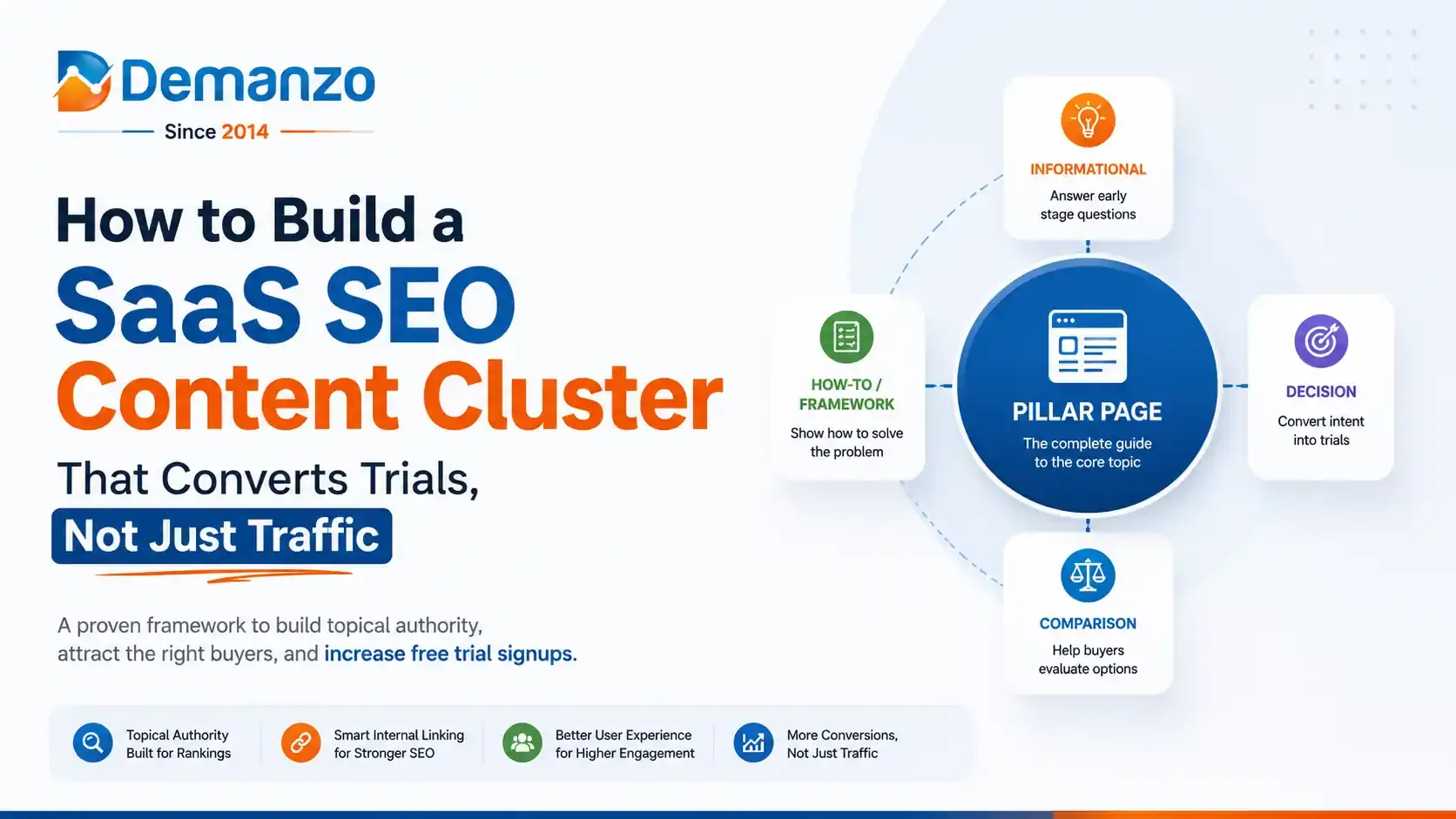
A content cluster is a group of related pages built around one main topic. It includes a pillar page that gives a complete overview and supporting pages that explain smaller topics in more detail. All the pages link to each other, making it easier for users and search engines to find useful information. It is not just a collection of random blog posts. A good content cluster follows a clear structure and helps turn visitors into customers.
A content cluster is a group of related pages built around one main topic. It includes a pillar page that gives a complete overview and supporting pages that explain smaller topics in more detail. All the pages link to each other, making it easier for users and search engines to find useful information. It is not just a collection of random blog posts. A good content cluster follows a clear structure and helps turn visitors into customers.
That part, most SEO guides already tell you. What they leave out is this: a cluster built only around awareness-stage topics will rank well and convert almost nobody. Traffic without transaction intent behind it just sits in your analytics dashboard, looking good in a monthly report.
A cluster that actually converts trials needs a mix of three content types working together:
● Informational spokes – These answer the “what” and “why” questions your buyer has early on. They build trust and pull in search traffic.
● Framework or how-to spokes – These show your buyer exactly how to solve their problem step by step. This is where you start planting your product as part of the solution, without turning it into a sales pitch.
● Comparison and decision spokes – These are built for buyers who already know they need a tool and are deciding which one. Pages like category tools compared or your product vs competitor belong here.
Most SaaS blogs are stacked with the first type and nearly empty on the third. That imbalance is exactly why traffic climbs while trials stay flat.
Step 1: Pick One Problem, Not One Keyword
Before you map out any pages, get specific about the one problem your cluster is going to solve. Not a topic area like “SEO” or “marketing automation” but an actual problem your ideal buyer is stuck on right now.
For example, instead of building a cluster around “SaaS SEO” broadly, build one around “How do we build SEO content that our sales team actually trusts?” That’s a real, narrow, urgent problem a VP of marketing is trying to solve, and it naturally leads to informational, how-to, and comparison content, all pointing at the same outcome.
Step 2: Build the Pillar Around the Framework, Not the Definition
Skip the “what is” pillar page. It’s the most crowded, least differentiated spot in search, and it rarely earns a click from someone ready to act.
Instead, build your pillar around a framework: a repeatable process for solving the core problem. Something like “The 5-Step Framework for Building an SEO Content Cluster That Converts.” A framework pillar does two things that a definition page can’t. It gives you a natural, logical structure for every spoke page to slot into. And it positions your company as the one that actually knows how to solve this, not just the one that can define it.
Step 3: Map Each Spoke to a Stage of the Buyer’s Journey
Once your pillar is set, list out five to eight spoke topics and tag each one by intent:
● Is this page for someone who just discovered the problem?
● Is this page for someone actively trying to fix it themselves?
● Is this page for someone comparing tools to fix it?
Aim for at least one comparison, or decision-stage spoke, for every two or three informational ones. If your current content calendar is 90% informational, that ratio alone explains a lot of your conversion gap.
Step 4: Write Product-Led, Not Product-Absent
Product-led SEO doesn’t mean turning every blog post into an ad. It means writing content where your product’s approach naturally shows up as part of the solution, because it genuinely is one.
If your how-to talk walks through building an SEO content cluster manually, show the manual way honestly. Then note where a tool (yours) removes the manual steps. The reader gets real value either way, and the ones who don’t want to do it manually now know exactly who to call.
Step 5: Link the Cluster with Intent, Not Just Structure
Internal linking inside a cluster usually just points every spoke back to the pillar. That’s fine for SEO, but it wastes an opportunity. Every spoke should also link to whichever service or product page solves the exact problem that the spoke discusses.
For a cluster like this one, that means linking your framework and how-to spokes to a page like your content writing services page, where the reader can see the execution side of what they just read about. The comparison spokes should link somewhere even more direct, like a free audit or consultation offer.
Step 6: Measure the Cluster by Trials, Not Just Traffic
Set up tracking so you can see which pages in the cluster are actually driving trial signups or demo requests, not just pageviews. Most analytics setups stop at “Which blog post got the most visits?” Push it further, down to “Which blog post led to a signup?”
You’ll usually find that your comparison and how-to spokes convert at three to five times the rate of your informational ones, even with a fraction of the traffic. That’s the number that should guide next month’s content calendar, not search volume alone.
Conclusion:
Most competitor content in the SaaS SEO space gestures at “build a content cluster” without ever showing the tactical difference between a cluster built for rankings and one built for revenue. That gap is where your next quarter of content should live.
If you’re a VP of marketing or the person in-house running point on this plan, you don’t need more blog posts. You need a cluster architecture that sends the right reader to the right page at the right moment, with a real path to a trial at the end of it. Want a second set of eyes on your current content cluster? Get a Free SEO & Competitor Audit and see exactly where your traffic is leaking out before it ever reaches a signup form.
Frequently Asked Questions (FAQ):
2. How is a content cluster different from writing regular blog posts?
Regular blog posts often target separate keywords without a clear connection. A content cluster links related topics around a central pillar page, creating a better experience for users and search engines. This structure helps visitors find more useful information, keeps them on your site longer, and improves your chances of ranking for multiple keywords instead of relying on individual blog posts.
3. Why are SEO pillar pages important for SaaS websites?
SEO pillar pages act as the foundation of your content strategy. They provide a complete overview of a topic and link to detailed supporting articles. This makes it easier for search engines to understand your website structure and helps users navigate related content. For SaaS businesses, pillar pages can also guide prospects from learning about a problem to exploring your product as the solution.
4. What is product-led SEO, and how does it help SaaS companies?
Product-led SEO creates content that naturally highlights your software while solving user problems. Instead of only targeting informational keywords, it includes product features, use cases, comparisons, and workflows that match buyer intent. This approach attracts visitors who are closer to making a decision, leading to more free trial signups, demo requests, and qualified leads.
5. How many pages should a SaaS content cluster include?
There is no fixed number, but a strong SaaS content cluster usually starts with one pillar page and five to ten supporting articles. As your website grows, you can continue adding related content. The goal is to cover a topic completely so users find answers to all their questions while search engines recognise your website as an authority in that subject.
6. How do internal links improve a SaaS content cluster?
Internal links connect your pillar page with supporting articles and related product pages. They help search engines discover and understand your content while guiding users to the next helpful resource. A good internal linking strategy spreads page authority across your website, improves rankings for related keywords, and encourages visitors to explore more pages before converting.
7. Should SaaS companies create comparison pages?
Yes. Comparison pages help users who are actively evaluating software options. Pages like "Your Product vs Competitor" answer common buying questions and highlight key differences. These pages target high-intent keywords and can attract visitors who are close to making a purchase decision. When written fairly and honestly, comparison pages often generate qualified traffic with higher conversion potential.
8. How long does it take for a SaaS content cluster to show SEO results?
Most SaaS websites start seeing improvements within three to six months, depending on competition, website authority, and content quality. Consistently publishing helpful content, building internal links, and updating existing pages can speed up results. SEO is a long-term strategy, but a well-planned content cluster often delivers sustainable traffic and qualified leads over time.
9. What topics should I include in a SaaS SEO content cluster?
Start with your customers' biggest questions and challenges. Include beginner guides, feature explanations, comparison pages, pricing topics, integrations, use cases, industry-specific solutions, and product tutorials. Supporting articles should answer different search intents while linking back to the main pillar page. This creates a complete resource that serves users at every stage of the buying journey.
10. How do I know if my SaaS content cluster is working?
Track both SEO and business metrics instead of focusing only on traffic. Monitor keyword rankings, organic visits, page engagement, internal link performance, free trial signups, demo requests, and conversions. If your content cluster is attracting the right audience and moving visitors toward your product, it is delivering value. Regular updates and optimisation will help maintain and improve performance over time.
2. How is a content cluster different from writing regular blog posts?
Regular blog posts often target separate keywords without a clear connection. A content cluster links related topics around a central pillar page, creating a better experience for users and search engines. This structure helps visitors find more useful information, keeps them on your site longer, and improves your chances of ranking for multiple keywords instead of relying on individual blog posts.
3. Why are SEO pillar pages important for SaaS websites?
SEO pillar pages act as the foundation of your content strategy. They provide a complete overview of a topic and link to detailed supporting articles. This makes it easier for search engines to understand your website structure and helps users navigate related content. For SaaS businesses, pillar pages can also guide prospects from learning about a problem to exploring your product as the solution.
4. What is product-led SEO, and how does it help SaaS companies?
Product-led SEO creates content that naturally highlights your software while solving user problems. Instead of only targeting informational keywords, it includes product features, use cases, comparisons, and workflows that match buyer intent. This approach attracts visitors who are closer to making a decision, leading to more free trial signups, demo requests, and qualified leads.
5. How many pages should a SaaS content cluster include?
There is no fixed number, but a strong SaaS content cluster usually starts with one pillar page and five to ten supporting articles. As your website grows, you can continue adding related content. The goal is to cover a topic completely so users find answers to all their questions while search engines recognise your website as an authority in that subject.
6. How do internal links improve a SaaS content cluster?
Internal links connect your pillar page with supporting articles and related product pages. They help search engines discover and understand your content while guiding users to the next helpful resource. A good internal linking strategy spreads page authority across your website, improves rankings for related keywords, and encourages visitors to explore more pages before converting.
7. Should SaaS companies create comparison pages?
Yes. Comparison pages help users who are actively evaluating software options. Pages like "Your Product vs Competitor" answer common buying questions and highlight key differences. These pages target high-intent keywords and can attract visitors who are close to making a purchase decision. When written fairly and honestly, comparison pages often generate qualified traffic with higher conversion potential.
8. How long does it take for a SaaS content cluster to show SEO results?
Most SaaS websites start seeing improvements within three to six months, depending on competition, website authority, and content quality. Consistently publishing helpful content, building internal links, and updating existing pages can speed up results. SEO is a long-term strategy, but a well-planned content cluster often delivers sustainable traffic and qualified leads over time.
9. What topics should I include in a SaaS SEO content cluster?
Start with your customers' biggest questions and challenges. Include beginner guides, feature explanations, comparison pages, pricing topics, integrations, use cases, industry-specific solutions, and product tutorials. Supporting articles should answer different search intents while linking back to the main pillar page. This creates a complete resource that serves users at every stage of the buying journey.
10. How do I know if my SaaS content cluster is working?
Track both SEO and business metrics instead of focusing only on traffic. Monitor keyword rankings, organic visits, page engagement, internal link performance, free trial signups, demo requests, and conversions. If your content cluster is attracting the right audience and moving visitors toward your product, it is delivering value. Regular updates and optimisation will help maintain and improve performance over time.
