

The threat isn’t AI itself. It’s the way people search and who they trust. The blue links are here to stay, but how they rank won’t be the same.
The Democratic Voting System
In the early days, there were no giant centralized platforms like Reddit and Meta. Blogs and niche forums were how people talked on the web. When Google launched, its core idea was simple: a link from one site to another counted as a vote, and it worked. Say a pet supply website seemed like a good investment back then. People would naturally mention the domain in their forum posts and write blogs about it, and those mentions served as organic votes that helped rank the domain higher.
If people spoke of a domain often, they’d probably look for it more often too. At least, that was the rationale.
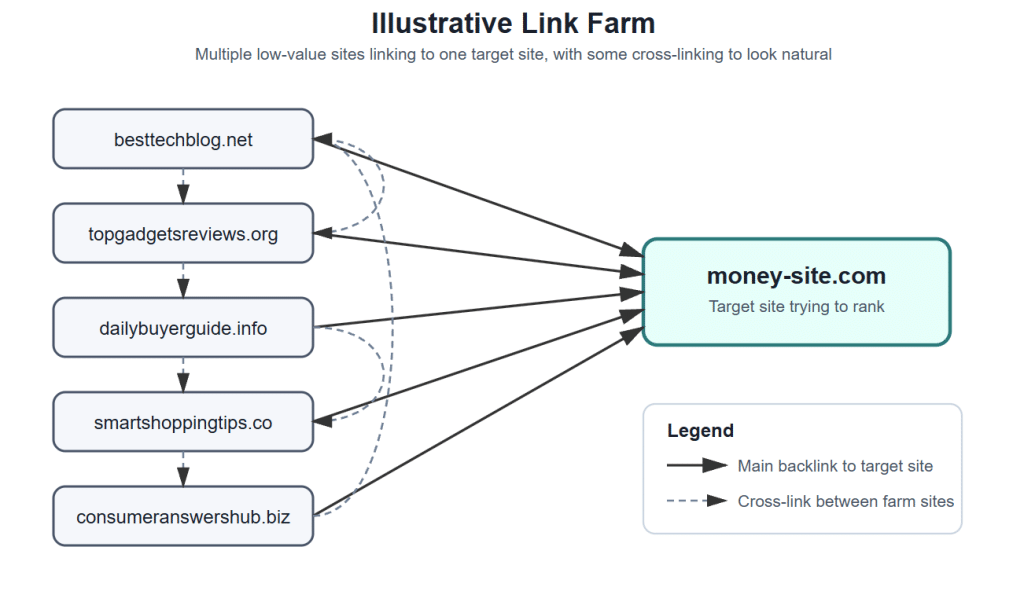
But like always, the system was prone to exploitation, and people began building “link farms”. A link farm, in essence, is a set of websites owned by the site owner or a backlink seller with the intention of passing authority on to a target domain. They often link to each other as well, so the whole network looks more natural than it is.
And it worked. Searches were manipulated, and manual human review played a huge part in curbing spam. The 2003 Florida update was one of the first big blows to these tactics. It hit keyword stuffing and manipulative linking, and it cleaned up the results noticeably.
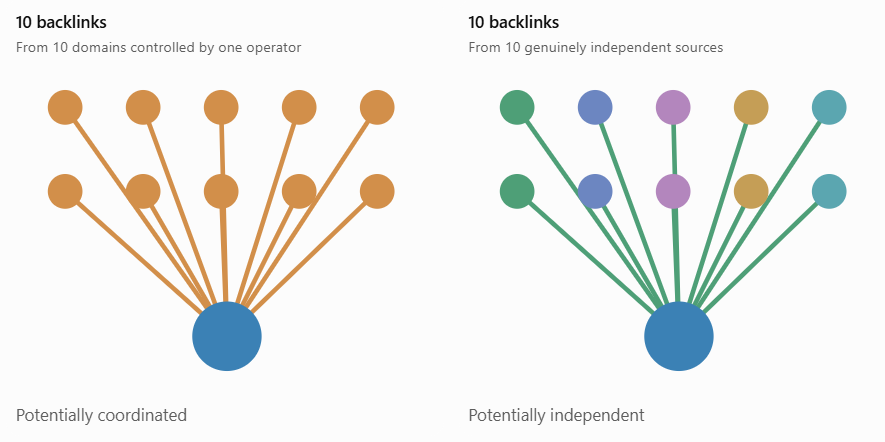
To be fair, PageRank never treated every link the same. A link from a respected page was always worth more than one from an unknown page. What link farms exploited was that authority could be manufactured cheaply. Google’s answer, over the years, was to stop taking every link at face value. Ten links from ten domains controlled by one operator are not ten votes. They are one vote cast ten times.
The Flaws In The New Voting System
The newer system wasn’t perfect either. Fake editorials, PR sites, and “guest post” blogs popped up. They published on diverse topics rather than shilling one domain like the old link farms did. The writing quality was usually sloppy, and their main intention wasn’t readership but selling backlinks.
Google fought back with a string of updates, most notably Panda in 2011, which went after thin, low-quality content, and Penguin in 2012, which targeted manipulative link schemes. They worked, at least for a while. But the algorithms were rule-based, and anything rule-based can be reverse-engineered. That’s why paid links and guest post networks are still a thriving business, and that’s where we are now.
The Future of Search
Google’s 2025 core updates (March, June and December) gave us a glimpse of what the future of search looks like. Core updates aren’t penalties in the strict sense, they re-evaluate which content deserves to rank. But the sites that lost ground were mostly the ones running on thin, duplicate and mass-produced pages. Google’s spam policies now call this out as “scaled content abuse”. Copy pasting AI output as a blog will no longer do. The content must be written with the intention of being useful to the reader.
Backlinks are changing too. What matters isn’t whether a site is big or niche. A link from a small, relevant site that a real editor chose to give is worth more than one from a bigger site that sells placements. The question search engines are really asking is whether a link is a genuine, independent endorsement.
Google already uses machine learning to answer that question, but language models are still nowhere near as good as humans at judging usefulness. Thin and spammy content does show up in AI Overviews, because a model can mistake linguistic perfection for usefulness. That won’t be the case for long. Cheap, fast decision models have started to arrive, like Jev by TypeSafe and OpenAI’s Decisions API. Instead of writing text, they return a structured judgment (a choice, a score or a yes or no, with a probability attached), and one call can answer a whole set of questions about the same input. Hypothetically, a search engine could ask: Is this written from first-hand experience? Does it add anything new? Is this link actually earned? And it costs next to nothing.
We don’t know if Google is working on anything like this. But should they bring such models into search, the results would be rather interesting. Contrary to the fear that AI Overviews will replace the blue links, we believe the blue links are here to stay. It’s only that the way they rank in the background won’t be the same. That said, clicks won’t look the same either. People already click through less when an AI summary sits above the results.
What If That Actually Happens?
It’s better to be safe than sorry. We’ve been in the SEO industry for over a decade now, and from what we’ve observed, there has been an uptick of social and community platforms being cited in AI Overviews. YouTube, Reddit, Quora, LinkedIn and Facebook frequently show up as sources. And it makes sense.
These platforms serve as a means for organic voice, and they are harder to rig. A fake profile will either be removed by the platform or can be checked against its activity history. It’s not impossible to fake, but building a believable history takes far more effort than buying a link.
As for blogs, despite being low in traffic, useful blogs do get cited in AI Overviews. Google Search Console now shows how often individual pages appear in AI-generated results, but it doesn’t provide a complete citation count. Third-party AI visibility trackers sample prompts and give a rough picture, but none of them can track every citation.
To Prepare Or Not To
It would be counterproductive to throw away the existing strategy for a speculative future. The best way to prepare is to center your SEO strategy around being genuinely helpful to readers and to optimize the website for user experience. Beyond that, be present where your audience actually talks. When a thread about your brand comes up on Reddit, reply through a representative account that’s clearly identified as the brand’s, and follow the community’s rules. Undisclosed promotion gets caught quickly and does more harm than silence. The brand must also stay active on social media and interact with its followers.
In short, the brand must be genuinely human. It’s pretty ironic that an artificial system is forcing brands to be more human than they’d naturally be.
Get Ready For AI-Driven Search With Demanzo
At Demanzo, we help SaaS, IT and B2B tech companies grow through SaaS SEO, demand generation and pipeline acceleration, and we’ve built our AEO (answer engine optimization) and GEO (generative engine optimization) services for exactly this shift. We’ll audit where your brand stands in AI search today, find the visibility gaps, and put together a plan to get you cited in AI Overviews, ChatGPT and other AI answers while keeping your organic rankings strong. Ready to own AI search before your competitors do? Get your free 90-day AI search roadmap from Demanzo.
